Callysta IoT platform

Callysta IoT platform

One connected foundation.Many real-world applications.

Callysta IoT Platform connects the complete journey—from devices and communications to data warehousing, analytics, monitoring, events, and alerting. One engineering foundation for operating connected assets and turning their data into useful decisions.

From physical to digital

Devices · Sensors · Embedded systems
Callysta IoT platformConnectivity · Commissioning · Device managementData warehouse · Analytics · MonitoringEvents · Alerting · Integration · Validation
Operational insight & actionDashboards · Reports · Response workflows · Automation

A shared foundation for further domain-specific solutions.

01 / Shared foundation

More than a device.
A connected workflow.

Connect assets, manage the fleet, retain and analyse its data, and turn operational events into action. Integration and validation run across the entire lifecycle.

01

Connect & commission

Bring devices into an operational system through defined discovery, pairing, registration, and commissioning workflows.

02

Manage & maintain

Manage device identity, configuration, health, and firmware throughout the fleet lifecycle—with controlled updates and recovery paths.

03

Data warehousing

Bring telemetry, events, and device history into a structured data foundation. Define retention, historical access, and business-system integration around each deployment’s needs.

04

Analytics & reporting

Turn measurements into context through historical trends, comparisons, operational indicators, and reports—helping teams understand performance and make informed decisions.

05

Monitoring, events & alerting

Bring fleet status and operational events into view. Define alert rules, priorities, notification channels, and escalation workflows around the people responsible for responding.

06

Integrate & validate

Connect embedded devices, mobile interfaces, enterprise systems, and operational applications. Validate complete workflows through application checks, real devices, and hardware-in-the-loop evidence.

Data models, analytics, retention policies, alert rules, and delivery channels are configured and qualified for each solution.

02 / Platform operations

Connect. Understand.
Stay in control.

From fleet connectivity and reliable updates to operational dashboards, mobile awareness, and the architecture for continuous operation at scale.
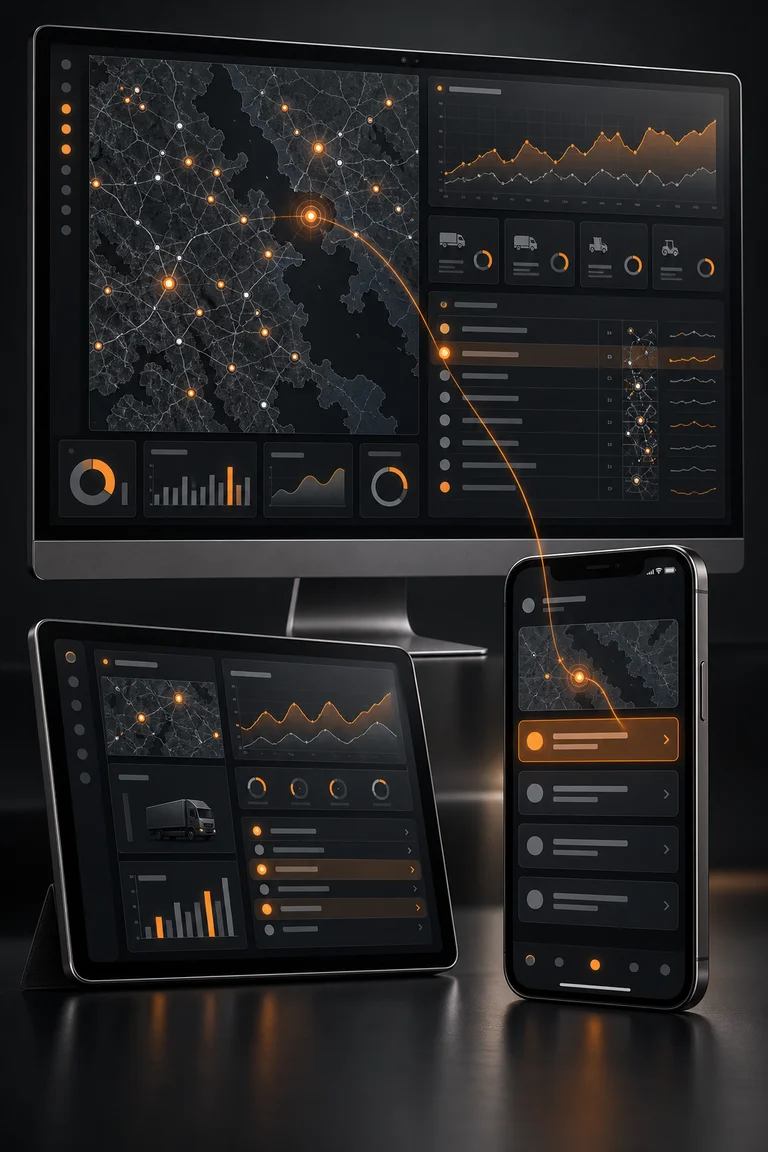
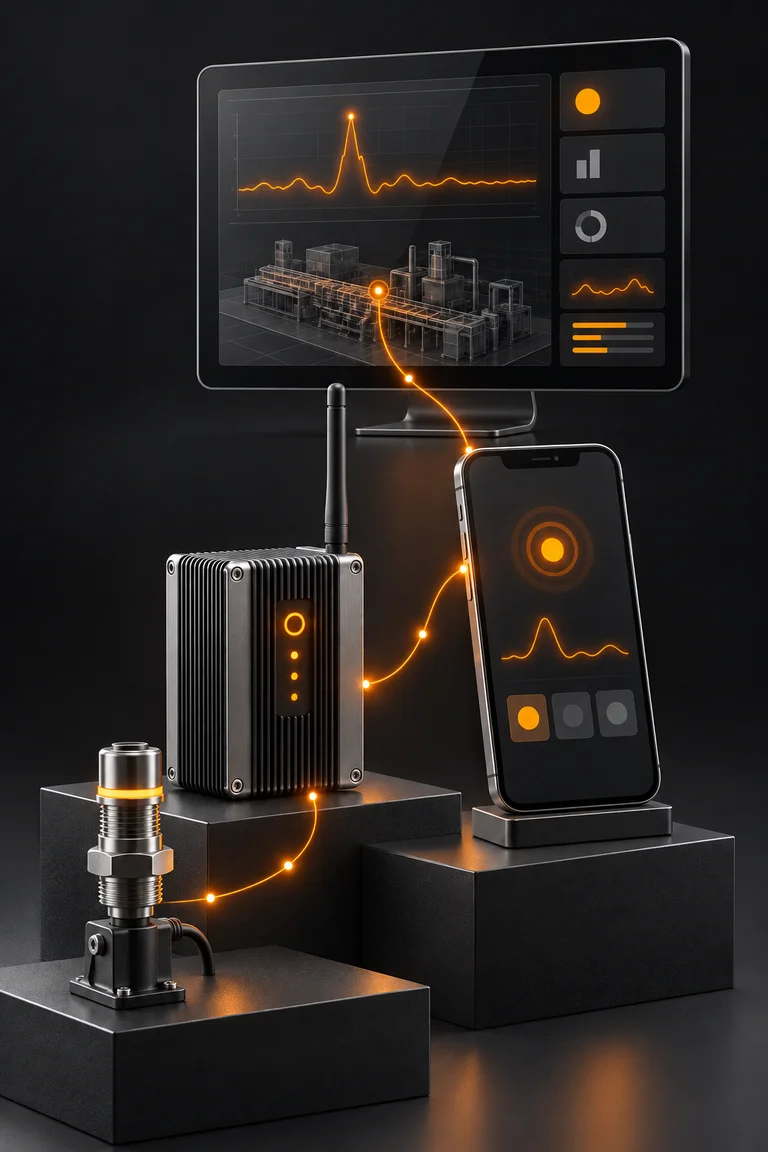
3D concept of an IoT monitoring dashboard linked to mobile devices with charts, fleet status, and notification tiles.

Monitoring dashboard · Analytics · Mobile

See the whole system. Act from wherever you are.

Bring fleet health, operational measurements, historical insight, and actionable events into a unified monitoring experience—connecting the control room with teams in the field.

A sophisticated operational dashboard
Combine device status, connectivity, sensor measurements, trends, and event history in focused views. Data warehousing and analytics provide the longer-term context behind current conditions, helping teams move from an overview to the devices and events that need attention.
Live events, meaningful notifications
Surface incoming events and threshold-based alerts in near real time when connectivity is available. Priorities, filtering, and deployment-specific rules help distinguish actionable conditions from routine activity. Notification channels and escalation policies are integrated and qualified for the intended response workflow.
Connected mobile workflows
Extend relevant status, alerts, and device context to mobile interfaces, so field teams can investigate conditions alongside commissioning and maintenance work. Configure delivery channels and response or acknowledgement workflows for each solution; mobile push, SMS, and email are not assumed to be enabled in every deployment.
3D architectural illustration of distributed device fleets, edge gateways, and interconnected server clusters.

Scalability · Reliability · Continuous operation

Think in millions. Engineer for every device.

Our architecture objectives bring together million-device scale and 24/7 continuous operation. Growth should not come at the expense of visibility, maintainability, or dependable field behaviour.
A path to millions of devices
We approach large fleets through distributed device management, workload partitioning, and independently scalable ingestion, processing, and storage. Capacity planning considers active connections, message frequency, payload size, retention, and update traffic—not device count alone. Million-device capacity is a design target, not a published benchmark of the current implementation.
Designed around 24/7 operation
Continuous operation calls for more than keeping a server running. Our deployment approach brings together health monitoring, fault isolation, redundancy planning, controlled maintenance, and tested recovery procedures. Availability targets and support arrangements are defined for each deployment; 24/7 operation is an engineering objective, not a guarantee of zero downtime.
Reliability from the edge to the platform
The implemented device foundation already includes bounded reconnection, acknowledged delivery for selected durable events, and verification-gated firmware updates. We build on these behaviours with deployment-specific capacity, endurance, failover, and recovery validation before expanding the fleet.
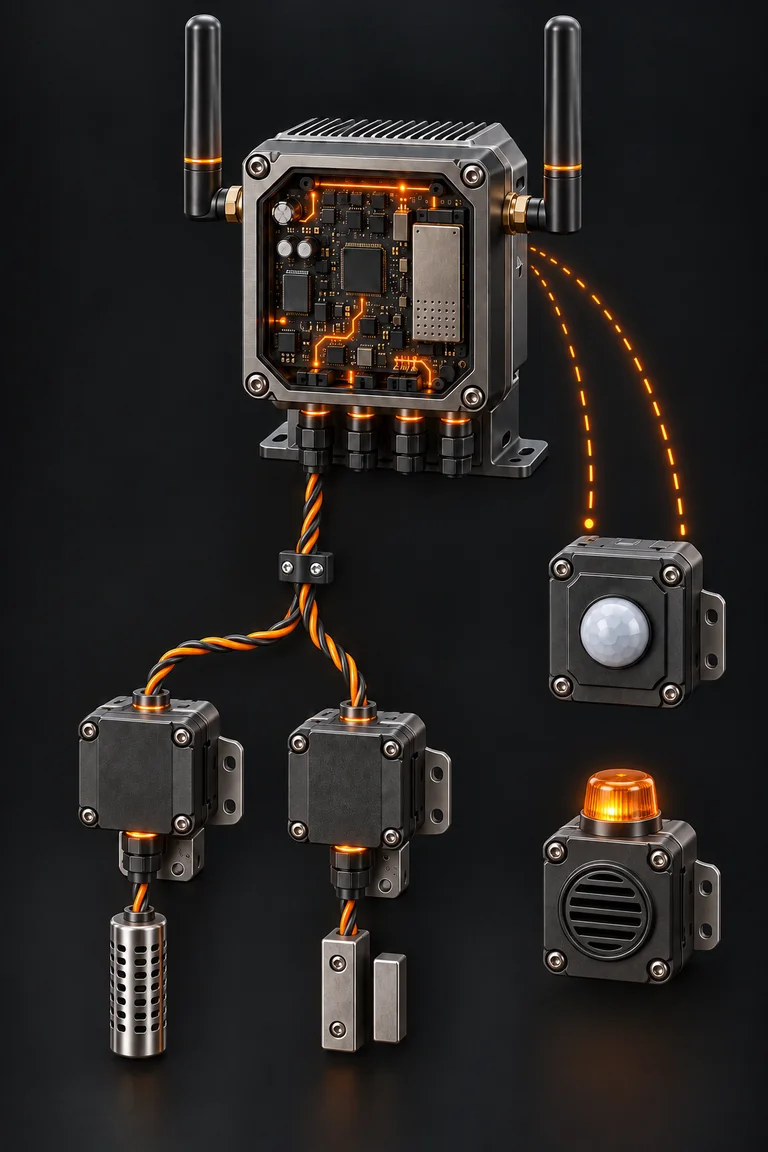
3D illustration of a 4G gateway with wired CAN nodes and separate wireless BLE motion and alarm devices.

4G · CAN bus · BLE · Sensors

From field signals to useful data.

One gateway brings together a wired CAN sensor network, supported BLE peripherals, and a managed 4G uplink.
Managed 4G connectivity
The gateway monitors modem registration and sessions, reconnects with bounded exponential backoff, and escalates modem recovery when needed. MQTT reconnects independently; selected durable, unacknowledged events are retried when connectivity returns—not all telemetry is buffered without limit.
Managed CAN sensor network
One coordinator manages multiple sensor nodes through rate-limited discovery, acknowledged identity and address assignment, and persisted associations. Bus-off recovery and rediscovery after restart or update help restore the network. Supported drivers and configurations are explicitly declared.
BLE sensing & actuation
Supported BLE peripherals connect wirelessly to the gateway, separately from the wired CAN network. Demonstrated workflows include secure discovery and pairing, PIR motion and battery sensing, and BLE alarm actuation. Peripheral support is integrated and qualified per device—not arbitrary Bluetooth compatibility.
Configurable wired & onboard sensors
Each CAN sensor node supports eight configurable GPIO inputs and a shared protected I²C bus. Qualified workflows include I²C discovery and access, temperature sensing, and the gateway’s onboard motion and power monitoring. Validated configuration mappings require acknowledgement and revert safely on invalid responses or timeout.
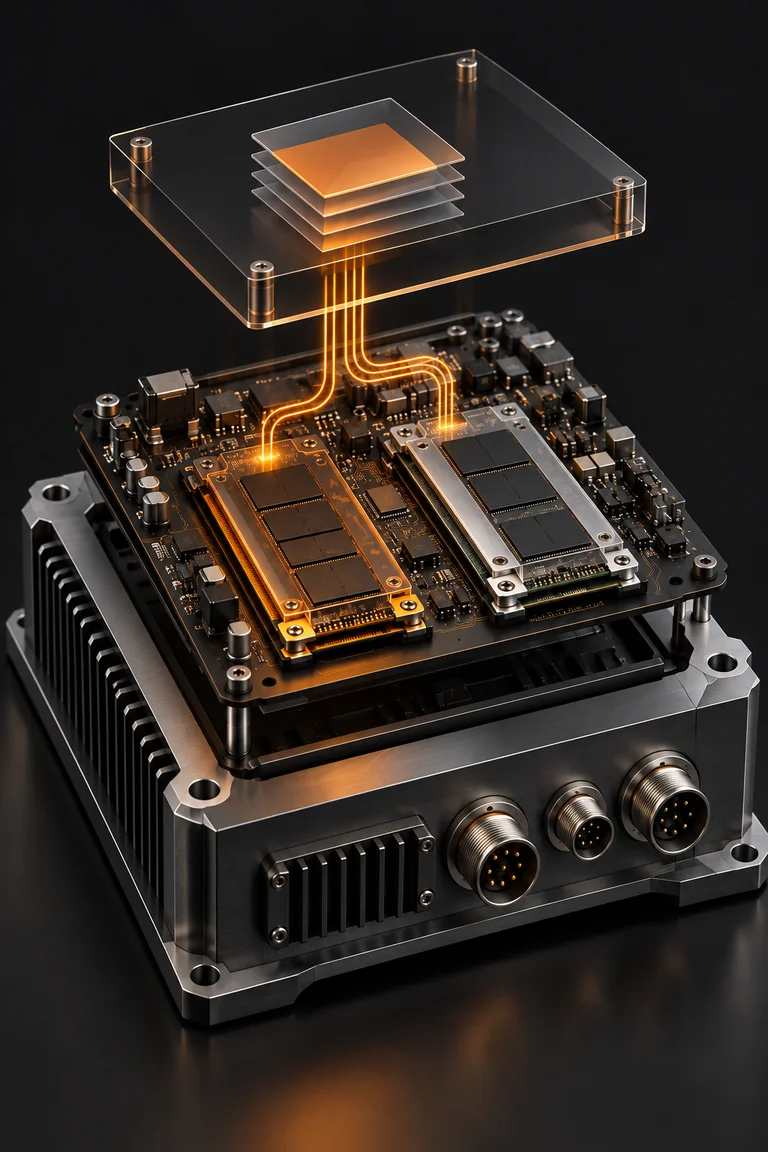
3D illustration of an embedded controller with active and standby memory modules.

Reliable OTA engineering

An update needs a recovery path.

Over-the-air updates must account for the realities of remote devices: interrupted connections, power loss, and different hardware revisions.
Verify the release
Signed manifests and checks for package hash, size, hardware, version, and anti-rollback policy gate staged activation. Firmware is accepted against the intended device—not just because a download completed.
Gateway rollback
The gateway updates an inactive firmware slot, then checks health during a probation period. If the new image fails those checks, it rolls back automatically. Recovery and interrupted-transfer scenarios have hardware-in-the-loop evidence.
Sensor-node recovery
Sensor-node updates use acknowledged CAN transfer, CRC verification, a protected bootloader, reset, rediscovery, and version confirmation. These nodes support bootloader recovery, not a second application image with automatic rollback.
3D concept illustration of sensor events reaching applications; notification channels vary by implementation.

Near-real-time events & notifications

Delivery is more than a broker receipt.

Prioritized device-to-platform event delivery provides timely awareness when connectivity is available, with explicit acknowledgement rather than assumed success.

Prioritized, identifiable events
Stable event identities and prioritized publication help the platform distinguish meaningful events and handle duplicates safely. Selected durable events remain available for retry across reconnects.
Backend acknowledgement
An application-level backend acknowledgement is required before an event is removed from its durable queue. MQTT broker QoS alone is not treated as confirmation that the application received it.
Notification channels
The demonstrated delivery boundary is device to platform. End-user push, SMS, email, escalation, and human acknowledgement require separate integration and qualification. Near-real-time delivery depends on connectivity; no fixed delivery time or zero-data-loss guarantee is implied.

Our platform foundation draws on implemented and demonstrated device workflows. Each deployment requires qualified hardware, supported sensor drivers, update safeguards, and a defined delivery scope. Additional sensor models and end-user notification channels require separate integration and qualification.

03 / Platform in practice

Commission with confidence.
Verify beyond the screen.

A connected device is only useful when its identity, configuration, and operational state can be trusted.

Our commissioning workflow brings together embedded devices, mobile interfaces, secure BLE pairing, backend registration, and assigned-device inventory. Supported configurations are validated and acknowledged before they become part of the operational system.

Validation connects the application to physical hardware: controlled device inputs, state checks, and evidence from both the device and software layers.

Demonstrated engineering workflows
  • Device discovery, pairing, and commissioning
  • Backend registration and assigned-device inventory
  • Real-device and hardware-in-the-loop validation

Communications portfolio

The right connection.
For every environment.

Our communications engineering portfolio spans metering, building automation, industrial systems, and connected products.

Cellular & long-range radio

4G · NB-IoT · LoRa

Connectivity engineering for distributed devices, remote monitoring, and metering applications.

Local wireless & mesh

BLE · 6LoWPAN · Zigbee · Wi-SUN

Wireless sensing, commissioning, and network integration for smart buildings and field systems.

Wired & power-line communications

CAN bus · Modbus · HPLC · G3-PLC

Device and system integration across industrial buses and power-line communication networks.

Wi-SUN FAN 1.1 engineering experience

A particular strength in connected field networks.

Wi-SUN FAN 1.1 is a key part of our communications engineering experience. We bring that experience together with our embedded hardware, firmware, metering, and backend capabilities to help customers develop integrated smart-metering and connected-field solutions—from product design through system integration and validation.

This is our broader engineering portfolio—not a claim that every protocol is enabled on every platform device. Hardware, protocol stacks, interoperability, and deployment requirements are selected and qualified for each project.

04 / Where we are heading

Built to extend.
Grounded in the use case.

Our direction is a reusable platform with domain-specific devices, integrations, and applications—not a one-size-fits-all product.

Metering

Connect measurements to operations.

Explore device commissioning, metering data integration, and utility workflows.

Building automation

Connect spaces to their systems.

Explore sensing, equipment monitoring, and integration with building operations.

IoT & smart products

Connect purpose-built devices.

Bring custom electronics, firmware, and software into a coherent product ecosystem.

These are development directions. Interfaces, supported devices, operational requirements, and delivery scope are defined and validated for each implementation.

Start with your use case

What will
you connect next?

Let’s define the devices, workflows, and integrations your system needs—and the evidence that will prove it works.

Discuss your IoT project